
Why Ukraine's air shield works against drones but struggles against ballistic missiles - The Times of India
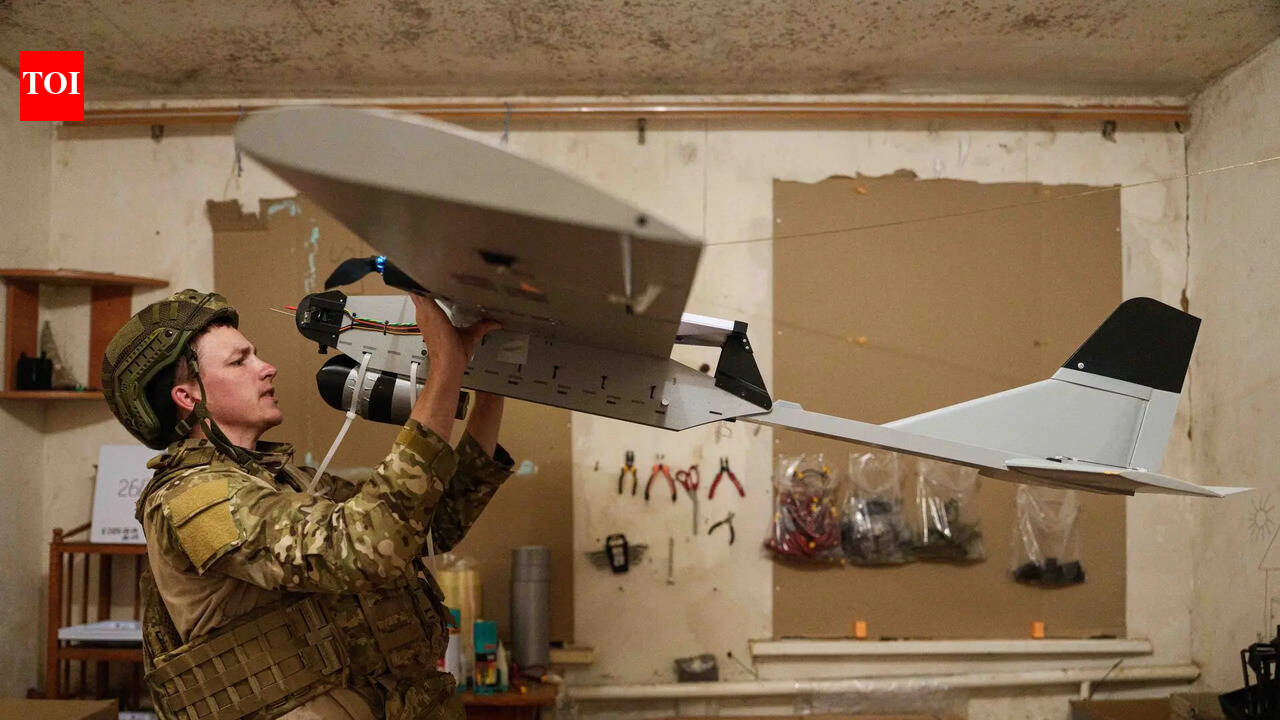
The conflict in Ukraine is now nearing the 1,600-day mark. The war has stretched a little longer than the First World War, or the Great War. There are many commonalities between how the two conflicts are being fought. The conflict, which was supposed to last three days, is now well into its fourth year.
The quick thrusts across territory have now devolved into First World War-style trench warfare. Just as aircraft made their first large-scale debut during the Great War, this conflict has seen the first large-scale deployment of drones in combat. The war has also pitched the weight of Europe behind Ukraine and against Russia, in a confrontation reminiscent of the Cold War.Europe's backing of Ukraine has helped stem the Russian tide.
Kyiv has been supported largely by NATO members from both sides of the Atlantic Ocean. It has been provided weapons that have helped hold back the Russian juggernaut. Initially, Ukraine kept Russian forces at bay with anti-tank missiles such as the American Javelin and the British Next-Generation Light Anti-armour Weapon (NLAW).Air defence weapons provided by Ukraine's partners kept Russian aircraft at arm's length after Moscow lost a slew of aircraft, especially helicopters, to surface-to-air missiles (SAMs).
This forced Russia to change tactics and reimagine the use of combat aircraft, relegating them largely to stand-off weapons. This has led to the now widespread use of glide bombs by Russia. Moscow has also increased the use of cruise missiles, which are being engaged by conventional weapons, and often resorts to ballistic missiles against Ukraine, which finds itself helpless against some of these attacks.NATO pledges more aid to UkraineIn the recently concluded NATO summit in Ankara, member states pledged a total of $80 billion in military assistance to Ukraine.
This sum will be delivered to the war-torn nation in the form of military equipment, assistance and training. Much of this equipment is procured by NATO members from the United States through the Prioritised Ukraine Requirements List (PURL) mechanism. From the beginning of the conflict till now, Ukraine has received military aid worth over $150 billion from NATO members.
Of this, $70 billion has been provided by the United States alone.Ukraine's defence against Russian aerial onslaughtFrom the early days of the operation, Ukraine has been the focal point of Russian air attacks and missile onslaughts. Ukraine's partners have, from the very early days of the conflict, provided Kyiv with air defence weapons.
These weapons have ranged from short-range point-defence Soviet-era ZU-23-2 air defence guns to advanced MIM-104 Patriot missiles, which are designed to engage targets flying at medium and high altitudes, up to a stated range of 160km. This weapon can also defend against tactical or short-range ballistic missiles.
The Pentagon has confirmed that a Patriot missile shot down a Russian Kinzhal hypersonic missile.Ukraine's air defence network has evolved considerably since the conflict began in 2022. At the time, Ukrainian air defence relied heavily on ageing Soviet-era systems such as the long-range S-300 and medium-range Buk to counter Russian missile strikes.
These systems were used against cruise missiles such as the Kh-101 and 3M14, as well as short-range ballistic missiles including the Iskander-M and Tochka-U.However, dwindling stocks of Soviet munitions posed a serious challenge, as replacements were unavailable. Slovakia donated a single S-300 battery, but Ukraine increasingly turned to Western partners for support.
Systems supplied included legacy platforms like the MIM-23B I-Hawk and modern solutions such as Germany’s IRIS-T surface-launched missile system, derived from an air-to-air missile.Germany also delivered Gepard self-propelled anti-aircraft guns, providing cost-effective defence against kamikaze drones, while other air defence artillery guns such as the ZU-23-2 improved protection against these systems.
In 2023, Ukraine received one SAMP/T and three Patriot batteries, adding limited capability against short-range ballistic missiles.Ukraine's western partners also improvised by adapting Soviet launchers to fire western missiles, such as the US-origin Sea Sparrow missile, which was made compatible with the Soviet Buk system under the “FrankenSAM” project.
Ukrainian initiatives further modified the R-73 for use with Osa systems. The result is a patchwork air defence network combining Soviet and western systems, which is holding the fort against air and missile attacks.Kyiv is currently building its defences against the threat of Russian ballistic missiles.
Russia has repeatedly fired the Oreshnik Intermediate Range Ballistic Missile (IRBM) at Ukraine. Kyiv has been unable to defend itself against this type of weapon. Ukraine has asked for newer variants of the Patriot missile and the US-made Terminal High Altitude Area Defense (THAAD) system. The latter is designed to take on ballistic missiles, improving Kyiv's ability to defend itself against this threat.The on-again, off-again conflict in West Asia has put additional pressure on the global supply and deployment of these missiles.
Ukraine has sought permission from the US to produce Patriot missiles in the country. US President Donald Trump has given the initial nod for the production of this missile system to Ukrainian President Volodymyr Zelenskyy on the sidelines of the NATO summit in Ankara, but nothing concrete has come of it so far.Drones: The deliverance for UkraineIn the initial days of the war, cash-strapped Ukraine attached small anti-tank warheads to drones and flew them directly at tanks.
This was a cheaper alternative to firing expensive anti-tank missiles at the hordes of Russian tanks streaming in from across the border. The drones were an instant success in combat. Now, nations across the world are devising new drones to take on the enemy and are simultaneously developing systems to defend against the threat of these flying systems.The emergence of these systems on the battlefield has restricted the movement of troops and equipment alike, necessitating the re-emergence of trenches in the open fields of eastern Ukraine.
In the last four years, Ukraine has written and then rewritten the book on drone warfare. Ukrainian drone operators regularly take part in exercises with NATO, where they demonstrate the lessons learnt in the fight against Russia.The employment of drones is increasing by the day. They are being used in conjunction with other firepower delivery means and even by themselves.
Drones are being tasked as loitering munition, and in swarms that can saturate enemy air defence and allow own missiles and aircrafts to conduct missions.The conflict has created an entirely new drone industry in Ukraine. The country is said to be on the path to make as many as seven million drones this year, while Ukrainian President Volodymyr Zelenskyy has stated that Ukraine has the capacity to produce twenty million drones domestically in 2026.Ukraine is using drones to fulfil different roles — to both see and strike.
In response, Russia too is producing drones to counter Ukrainian systems. Moscow has also been using larger kamikaze drones, updated variants of the Shahed drones first developed by Iran. Ukraine has even deployed a drone-based interceptor, called Griffin, to take down these low-cost projectiles launched by Russia.Ukraine is also pioneering maritime and ground combat drones.
It is now promoting its drone industry and working to export drones and drone-based solutions to other nations.The conflict in Ukraine is now one of the longest conflicts fought on European soil since the beginning of the industrial age. Even after four years of fighting, both sides are still looking to gain an upper hand before they sit down to talk.
As the fighting continues, neither side is gaining a critical advantage over the other. The world watches on as both countries increasingly attack targets deeper behind the frontlines, providing lessons to others about how the latest technology is reshaping the contours of war.