
Will Iran give up control of the Strait of Hormuz?
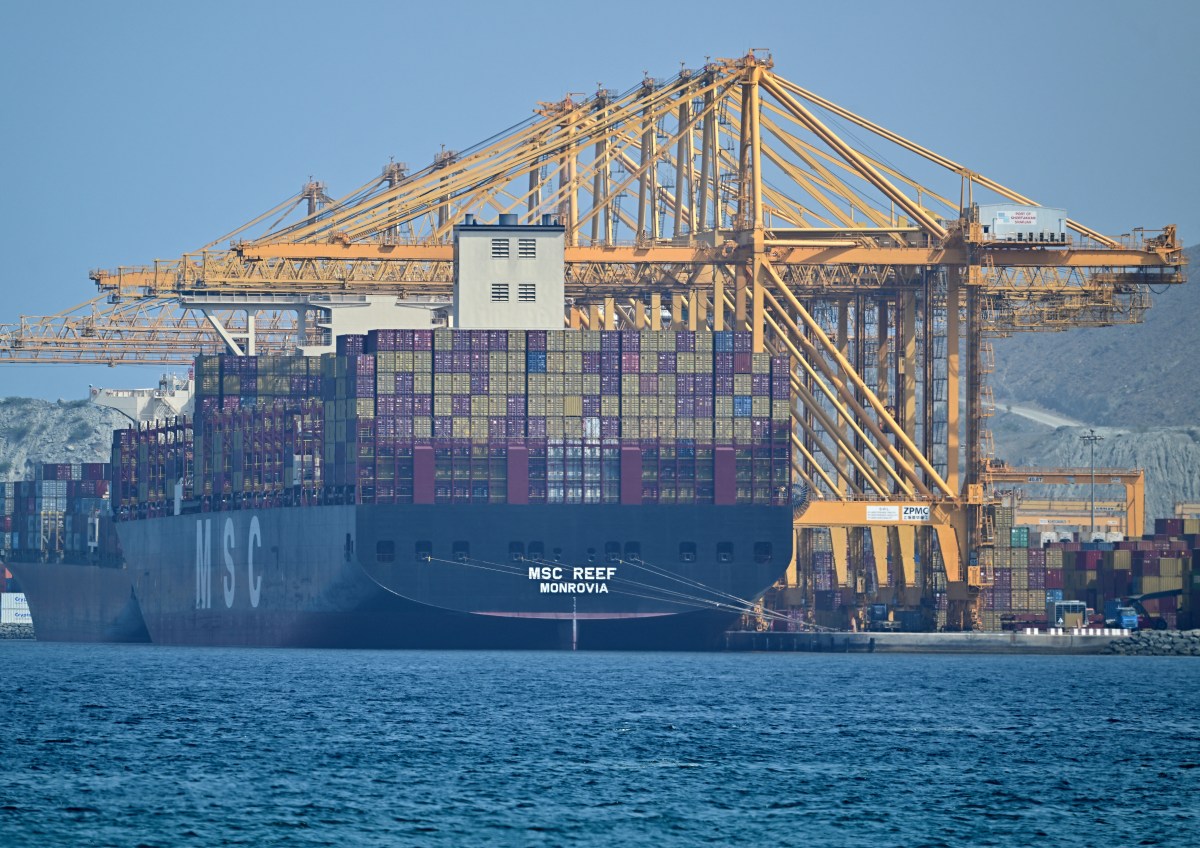
A flare-up in hostilities between the U.S. and Iran on the weekend amid conflicting claims about who controls the Strait of Hormuz has raised concerns over whether Tehran will ever fully relinquish the waterway and what the U.S. can do about it.
"It is unlikely that Iran will give up this strategic leverage," Gala Riani, head of strategic intelligence, at security firm S-RM, told Newsweek on Monday.
Robert Murrett, retired US vice admiral, told Newsweek the quantity of vessels that transit the waterway meant,“there's no real military solution to keeping the Strait open."
"There's going to have to be some diplomatic agreement with the Iranians," he added.
Diplomacy had promised much on June 17 when a memorandum of understanding (MoU) signed by President Donald Trump and his Iranian counterpart, Masoud Pezeshkian, ended the three-month Iran War and kick-started further talks.
But on Saturday, an Iranian drone struck Panama-flagged M/T Kiku, prompting U.S. military aircraft to hit back at Iranian military infrastructure.
U.S. Central Command said Iran had breached the ceasefire agreement and Trump accused Tehran of violating the memorandum. The Islamic Revolutionary Guard (IRGC) launched drones and missiles on the US Fifth Fleet Naval Base in Bahrain and the Ali Al Salem Airbase in Kuwait on Sunday.
While both sides agreed to stand down Monday, the fracas adds to uncertainty over the ability of the framework deal to end the war on all fronts and keep the Strait of Hormuz open amid great caution from insurers and ship owners.
"With the threat of attacks hanging over the Strait, it’s still a tense time for shipowners," Susannah Streeter, chief investment strategist, at Wealth Club told Newsweek. "While the key waterway may have reopened, it’s far from business as usual."
The U.S. insists the Strait was fully open but Iran’s Foreign Minister Abbas Araghchi said the full restoration of maritime traffic was "Iran’s responsibility."
It means that shipowners are still navigating an uneasy route, with elevated war-risk insurance premiums and lingering bottlenecks adding to the cost of transit—and the stakes for the U.S during this week’s Doha talks.
Before the U.S. and Israel launched joint strikes on Iran on February 28 that started the Iran War, one-fifth of the world’s hydrocarbons had transited through the Strait of Hormuz which, as an international waterway, was not controlled by any single country.
But Iran is seeking to retain its grip on the waterway which it had charged vessels to use in breach of international maritime law, a fee which was waived for 60 days with no clarity on what happens after this.
"Iranian officials have continued to hint that service fee could be introduced once the 60-day period expires," said Streeter, "Even the possibility is enough to keep shipping companies on edge."
Oman, which borders the strait along with Iran, has coordinated with the International Maritime Organization (IMO) to open temporary shipping corridors along the Omani coast, allowing vessels to bypass the routes controlled by IRGC.
But the IMO had paused on Thursday an evacuation effort for hundreds of stranded ships and thousands of seafarers out through the Strait of Hormuz, after a vessel was attacked in the Gulf of Oman.
Clionadh Raleigh, CEO of ACLED (Armed Conflict and Location Event Data) said that discussions between Iran and Oman over the management of the waters are sensitive, with Tehran stressing that any arrangements must strictly respect the sovereignty and rights of all littoral states.
Raleigh said that Oman had been engaged in a backroom deal regarding a southern route that adheres much more to its coast than to the northern, Iranian-controlled routes. This would deny "quite a bit of Iran's control over the strait."
"If Iran cannot use its chokehold on the strait to reinforce its position, or to charge countries for their supplies to go in and out, it really weakens its position as it goes into negotiating the terms of this agreement," said Raleigh. "Ultimately, the Gulf states are trying to organize toward their own collective security here—an effort I am sure Trump is not particularly interested in."
Riani from S-RM said Iran views its control over the Strait "as an existential lifeline" that has allowed the regime to survive and imposing a heavy cost on the international economy has been key to forcing all parties to the negotiating table.
If Iran’s plans to charge vessels is deemed unacceptable to the U.S., Riani said "the range of options on the table for applying pressure on the regime include the potential return to military conflict, naval and economic blockades, and tightened sanctions."
There are many facets to the 14-point framework deal to be hammered out over the next 60 days.
As well as ambiguity over what will happen regarding transit fees, there are the status of Iran’s nuclear program and Tehran’s tying of any deal to an end to hostilities in Lebanon, where Hezbollah has been exchanging fire with Israel. Hezbollah entered the war on March 2 after launching rockets into Israel in support of its main backer, Iran.
Rajneesh Narula, professor of international business regulation, Henley Business School, England, told Newsweek that Tehran believes that in the absence of a wider deal, particularly with Trump unable to get the Israelis to stop bombing Lebanon, "the agreement is null and void."
With only about half the normal number of ships going through the strait as before the war, Tehran's insistence of tariffs shows "they are signaling that without the goodwill of Iran; nothing will go forward," Narula added.
Murrett, deputy director at the Institute for Security Policy and Law at Syracuse University, said that a long-term deal on the strait would need the U.S. to get diplomatic help from the U.S.’s Gulf partners. "The ongoing attacks in Lebanon, responses by Kuwait and Bahrain to the recent Iranian attacks—”these regional issues are all connected."
"It's clear that the Iranian leadership does not speak with one voice. There are ongoing disputes between the ‘hard-liners' and the ‘pragmatists' and this dynamic will continue to loom large," added Murrett. "The Iranians can hold the strait at risk from a commercial standpoint," he said, "they can do so with weapons that they can make in garages and basements."