
Xi offers AI olive branch to the world, calling for ‘symphony of global cooperation’
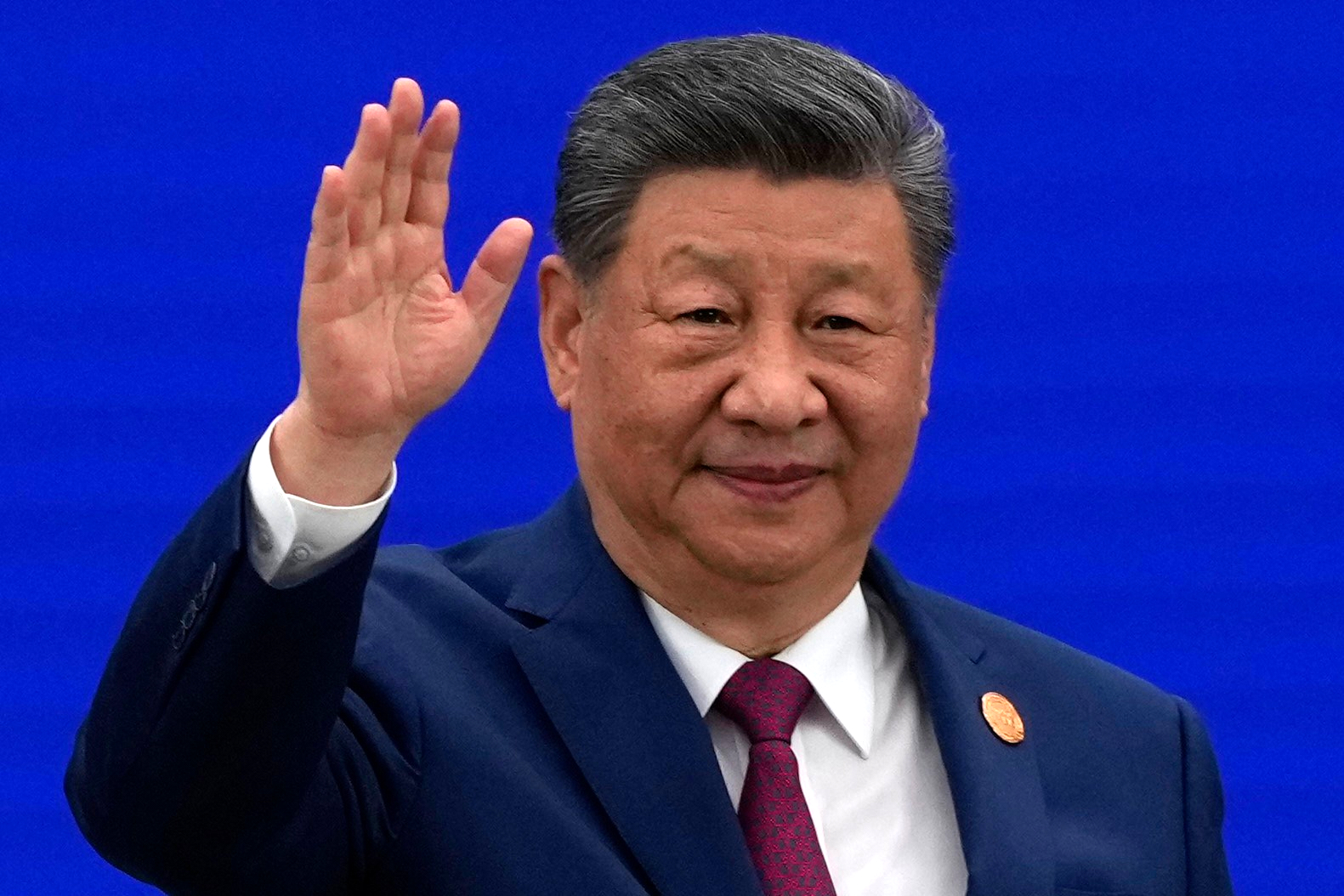
Development and governance of artificial intelligence should be a global effort, Chinese President Xi Jinping said Friday, while reiterating China’s objections to what he called the “overstretching” of national security concerns.
Speaking at a conference in Shanghai, Xi said AI should not be dominated by any single nation. American-led restrictions have blocked China from accessing some of the world’s most advanced technologies, spurring China’s efforts to build its own know-how and intensifying the rivalry between the world’s two biggest economies.
“The development of artificial intelligence should not be a solo performance by any single country but rather a symphony of global cooperation,” Xi said at the opening of China’s annual World Artificial Intelligence Conference in Shanghai. Others attending included the leaders of Kazakhstan, Cambodia and Thailand and U.N. Secretary-General António Guterres.
“We should together oppose the practice of overstretching the concept of national security in the field of artificial intelligence, and of placing one’s own security above that of other countries,” he said, repeating a longstanding Chinese complaint.
China will expand AI cooperation with the Association of Southeast Asian Nations, the League of Arab States, the African Union, the Community of Latin American and Caribbean States, the Shanghai Cooperation Organization and the BRICS countries, Xi said. He promised to provide access for 30 countries to a Chinese-developed AI meteorological tool that provides early warning systems.
Over the next five years, Xi said China will provide 5,000 AI training opportunities to developing countries.
Closer partnerships can help prevent “historical injustice in AI,” he said.
Ahead of the conference, 29 countries including Pakistan, Russia and Kazakhstan signed an agreement with China to establish a World Artificial Intelligence Cooperation Organization. State media described it as an intergovernmental organization headquartered in Shanghai promoting global AI governance.
The new AI cooperation organization can be viewed as China’s answer to the U.S.-led Pax Silica initiative, said George Chen, partner and chair of digital practice at Washington-headquartered consultancy The Asia Group.
The Pax Silica framework, launched late last year, focuses on strengthening collaboration with U.S. allies and partners on AI-related supply chains. Signatories include Japan, the U.K., Australia, the Philippines, Israel and India.
Following a visit by U.S. President Donald Trump’s to Beijing to meet with Xi in mid-May, China and the United States also agreed to conduct a dialogue on AI development and governance.
Chen, who was at the conference in Shanghai, also said Xi’s speech can be seen as a signal that China can be a reliable partner to the developing world, or “Global South” countries. “China will not let America be the monopoly of AI technology.”
More than 1,100 companies and 1,400 guests are participating in the annual AI conference this year, Chinese state media said.
During the conference that runs until Monday, tech giant Huawei is showcasing its powerful AI computing system, the Atlas 950 SuperPoD.
Some technology analysts now believe China has become an innovator in AI and is no longer just catching up with the U.S. China’s five-year plan until 2030 has prioritized progress in frontiers of science and technology including AI.
China’s open-source AI models, like DeepSeek, are seen, especially across the developing world, as appealing and often more affordable than U.S. AI models, which are largely closed-source.
Coinciding with the conference, the Chinese AI startup Moonshot released its latest AI model, Kimi K3. It said Kimi K3’s 2.8 trillion parameters — one of the measurements of an AI model’s capability — will make it the world’s largest open-source model. DeepSeek’s V4 Pro version has 1.6 trillion parameters.
Last month, another Chinese AI company Zhipu, or Z.ai, rolled out its new flagship GLM-5.2 open-source model in a challenge to U.S. rivals including Anthropic’s models.
But U.S. politicians and several major U.S. AI companies including Anthropic have accused Chinese AI models of illicit “distillation” of their models to extract their technologies, a claim that Beijing says is “groundless.” U.S. policymakers have also raised concerns over Chinese AI posing an economic threat to the United States.
Chan reported from Hong Kong. Associated Press writer Ken Moritsugu contributed from Beijing.