
Xi, Putin, Kim flex muscles in Pacific as Trump pulls last aircraft carrier
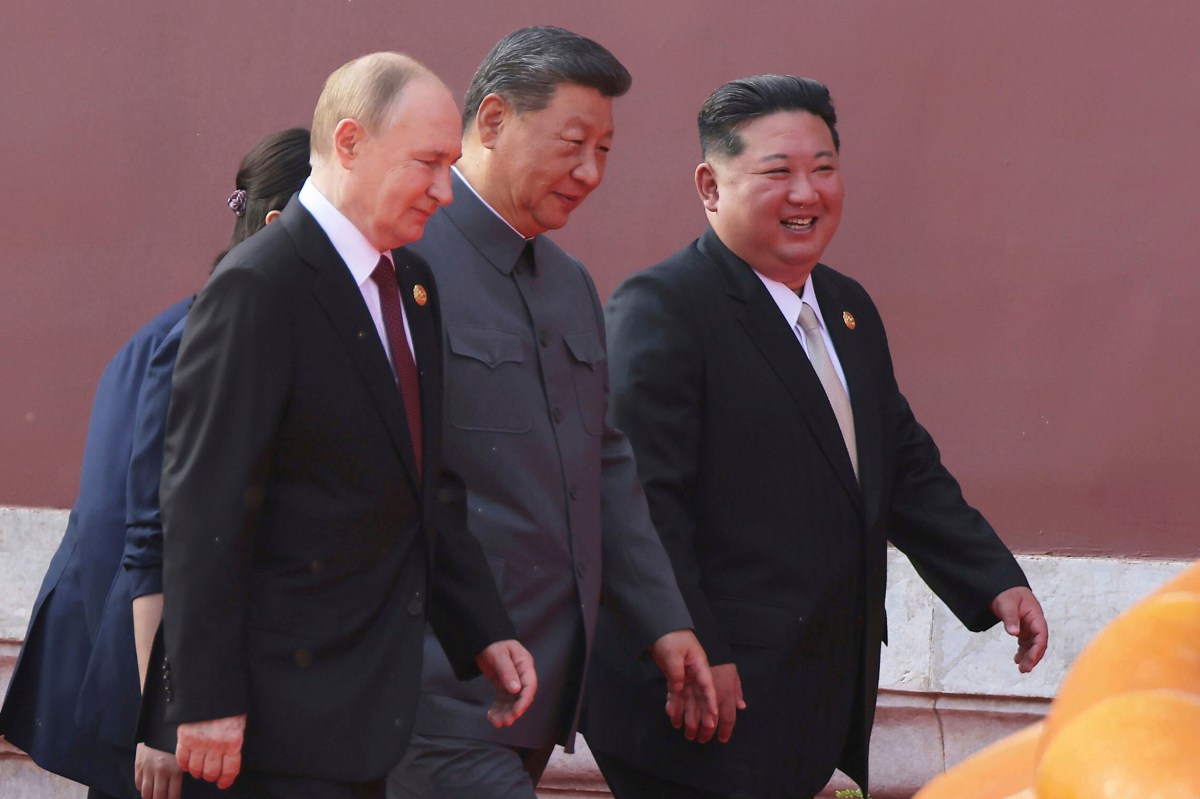
With President Donald Trump ordering the U.S. Navy's only actively deployed aircraft carrier in the Asia-Pacific to aid operations in the Middle East, Washington's top three rivals in the region have only stepped up challenges to U.S. partners.
Reports first emerged earlier this month that a new aircraft carrier would be sent to relieve the USS Abraham Lincoln, amid concerns raised by sailors' families over deteriorating conditions aboard the ship after a deployment exceeding 260 days—far beyond the standard six-month tour—in support of operations against Iran. The replacement was later confirmed to be the USS George Washington, now en route to U.S. Central Command's (CENTCOM) area of operations from a port visit to Vietnam.
But as the last carrier leaves the western Pacific, a trio of U.S. challengers consisting of China, Russia and North Korea have only ramped up military activities.
"I'm sure they're quite happy about this deployment," Raymond Kuo, vice president of research for geostrategy and diplomacy, told Newsweek. "While the U.S. still has ground and air forces at regional bases, the absence of a carrier group means Washington has lost its key power projection tool. We are much less able to contest Chinese and Russian naval and coast guard operations."
"The deployment also suggests that CENTCOM doesn't have the necessary means to defeat Iran without drawing from other regions," Kuo said. "This calls into question America's capabilities in a future conflict against more powerful opponents, all while reducing U.S. military readiness right now for no strategic gain."
While the aircraft carrier gap limits military options in the region, the U.S. continues to maintain a number of bases, including aircraft and warships. The absence is also likely to be temporary.
The U.S. Navy maintains 11 nuclear-powered aircraft carriers, although usually around half are actively deployed at any given time. Options to replace the USS George Washington in the western Pacific region include the USS Theodore Roosevelt, which is preparing for a possible deployment from San Diego later this year, and the USS Carl Vinson, which is currently underway in the eastern Pacific following upgrades, renovations and maintenance.
In addition to the USS Abraham Lincoln, the USS George H.W. Bush carrier strike group is also operating in the Middle East. The USS Gerald R. Ford departed the region in May amid a post-Cold War record deployment of 326 days that spanned support for NATO in the Arctic, the U.S. intervention in Venezuela and the U.S.-Israeli war against Iran, during which a reported laundry room fire forced the ship to undergo repairs in the Mediterranean.
But Trump's latest carrier shuffle was accompanied by other developments that have raised concerns about U.S. military readiness, including a pause in arms sales amid dwindling munitions stockpiles due to the war on Iran, as well as Trump's announcement Sunday that he would order the Pentagon to scale back joint military exercises with South Korea.
Trump criticized South Korea for not sufficiently supporting the U.S. in its conflict against Iran and suggested that the annual drills were "totally inappropriate and hostile" toward North Korea at a time when Pyongyang had been "unthreatening and respectful."
While North Korean Supreme Leader Kim Jong Un has avoided direct criticism of Trump, who has described his relationship with the ruler as "very good," North Korea has pressed on with hostile rhetoric toward U.S. allies South Korea and Japan. Last Wednesday, authorities in Seoul and Tokyo reported Pyongyang's second ballistic missile launch in less than a week in actions viewed as a likely protest against the scheduled joint U.S.-South Korea exercises.
Kim was not alone in taking action amid military drills involving U.S. partners.
China has issued scathing remarks in response annual training recently conducted by Taiwan, the self-ruling island claimed by Beijing and supported through military assistance by Washington. China went on to conduct what it called a joint maritime drill of its own with Indonesia, not far off Taiwan's coast, though Jakarta downplayed the maneuvers as being "not intended as combat training."
The White House has repeatedly reaffirmed its support for Taiwan, though Trump stated during his visit to meet Chinese counterpart Xi Jinping in May that he would coordinate with Beijing on arms sales to Taipei, ultimately pausing a $14 billion package.
Russia has also recently reasserted its Pacific presence as its war thousands of miles away in Ukraine rages on. Amid large-scale exercises near the disputed Kuril Islands, President Vladimir Putin last week paid an unprecedented visit to the chain seized from Japan by the Soviet Union during World War II and still claimed by Tokyo to this day.
Putin's arrival sparked an outcry from Japanese officials, who have also reportedly raised concerns over the U.S. decision to cancel joint exercises with South Korea. While Trump has spoken highly of Japan's role in their alliance in recent months, he has also referred to the terms of the decadeslong pact as "unfair" and has called on Tokyo, like Seoul, Taipei and other U.S. partners, to commit more to its own defense.
"Given Trump's statements, it certainly seems like the U.S. is holding its defense relationships hostage to their adversaries, not only with Taiwan, but also more broadly," Kuo said. "We're starting to see Asian allies turn to each other for support in light of these questions about American commitment and intentions."
Meanwhile, China, Russia and North Korea have all stepped up cooperation in recent years. Although they maintain no formal trilateral military mechanisms, Pyongyang holds a historic security pact with Beijing dating back 65 years, and more recently forged a mutual defense agreement with Moscow in 2024.
China and Russia have no such alliance between them. However, they continue to foster a comprehensive strategic partnership through various joint ventures, including naval exercises conducted by the two powers in the Pacific last month and alongside Iran in the Gulf of Oman and northern Indian Ocean in February, shortly before the U.S.-Israeli war launched against the Islamic Republic.
Andrea Kendall-Taylor, a former U.S. national intelligence officer serving today as senior fellow and director of the Transatlantic Security Program at the Center for a New American Security, referred to the growing ties among the trio and Tehran as an "Axis of Upheaval," which acts as "a force multiplier for U.S. adversaries."
She did not anticipate any imminent action on their part as a result of the latest shake-up of U.S. force posture in the region but argued that the move may feed into rivals' efforts to portray the U.S. as unable to sustain its attention across the globe.
"I don't think the carrier movement will change their immediate behavior. But it reinforces a perception that the United States is increasingly forced to divide its attention and military resources across multiple theaters," Kendall-Taylor said.
"That's one of the key strategic benefits China, Russia, Iran, and North Korea derive from their growing cooperation," she said. "They don't need to coordinate every action; simultaneous challenges across Europe, the Indo-Pacific, and the Middle East act as a geopolitical pressure multiplier that strains U.S. attention, resources, and military posture. That in turn creates openings for each to pursue its own objectives while collectively eroding U.S. power and influence."
Even if few expect any overt challenge to U.S. influence in the short term, the notion that China, Russia and North Korea could capitalize on a perceived retreat by the Trump administration from one of the world's most strategic theaters looms over analysis by observers.
"We certainly hope that they don't see this as a window of opportunity where the U.S. is weak and distracted," Center for Strategic and International Studies Defense and Security Department senior adviser Mark Cancian, who previously served as chief of the Force Structure and Investment Division at the White House's Office of Management and Budget, told Newsweek.
"There's no question that these actions reduced the level of deterrence—the inventories, the absence of most of the fleet, and statements that raise questions about U.S. commitment," Cancian said.
In the past, he pointed out, the U.S. might opt to reassure regional partners with a show of force, such as a U.S. B-52 bomber build-up in the remote U.S. Pacific island territory of Guam. It's a tactic Trump has used as well amid previous rounds of tensions, though Cancian saw no evidence that the administration was planning to apply it today as the Persian Gulf crisis continued to command the White House's focus.
But for Beijing, Moscow and Pyongyang, Cancian said their maneuvers and growing cooperation have a distinct message to those who have intertwined their security with commitments from Washington: "We're here. The U.S. is unreliable. Make a different deal."
The impact may not be limited to the Asia-Pacific, either. Analysts have warned waning U.S. arms stockpiles and strains in ties with NATO allies scrambling to undergo a major European rearmament campaign may also open a "window of opportunity" for Russian escalation.
Still, Cancian noted that it may be some time before any lasting shifts in U.S. strategy could be determined with any certainty.
"It's important to see what happens over time, and it could happen that the exercises resume. That's what happened last time," Cancian said. "It could be that the war in the Middle East winds down enough that some of those ships can come back. The Washington is going out, but maybe at some point we decide that one carrier is enough and leave the Bush there and bring the Washington back.
"Things will change over time, and those changes will give us more insight into which direction U.S. policy in the region is heading," he added. "Is it heading towards more autonomy from the U.S. or do we go back to the strong ties that we've had for so many decades?"