
citations.press Partners with LLM Scout to Turn AI Visibility Gaps into Citable Evidence
The partnership connects AI visibility monitoring with structured, source-backed publishing, so brands can see where they are missing from AI search answers and take practical steps to improve how easily ChatGPT, Claude, Gemini and Perplexity can discover and cite them.
citations.press, the structured citation index built for AI search and generative engine optimization (GEO), today announced a strategic partnership with LLM Scout, an AI visibility and brand monitoring platform. The partnership helps brands identify where they are missing from AI-generated answers in ChatGPT, Claude, Gemini and Perplexity, then take practical steps to make their verified information easier for AI systems, search engines and journalists to discover and cite.
Key takeaways
- citations.press and LLM Scout have formed a strategic partnership connecting AI visibility measurement with citation-ready publishing.
- LLM Scout measures brand mentions, share of voice, prompt coverage and competitor citations across ChatGPT, Claude, Gemini and Perplexity.
- citations.press publishes verified facts as structured, machine-readable citation records built for AI retrieval and generative engine optimization (GEO).
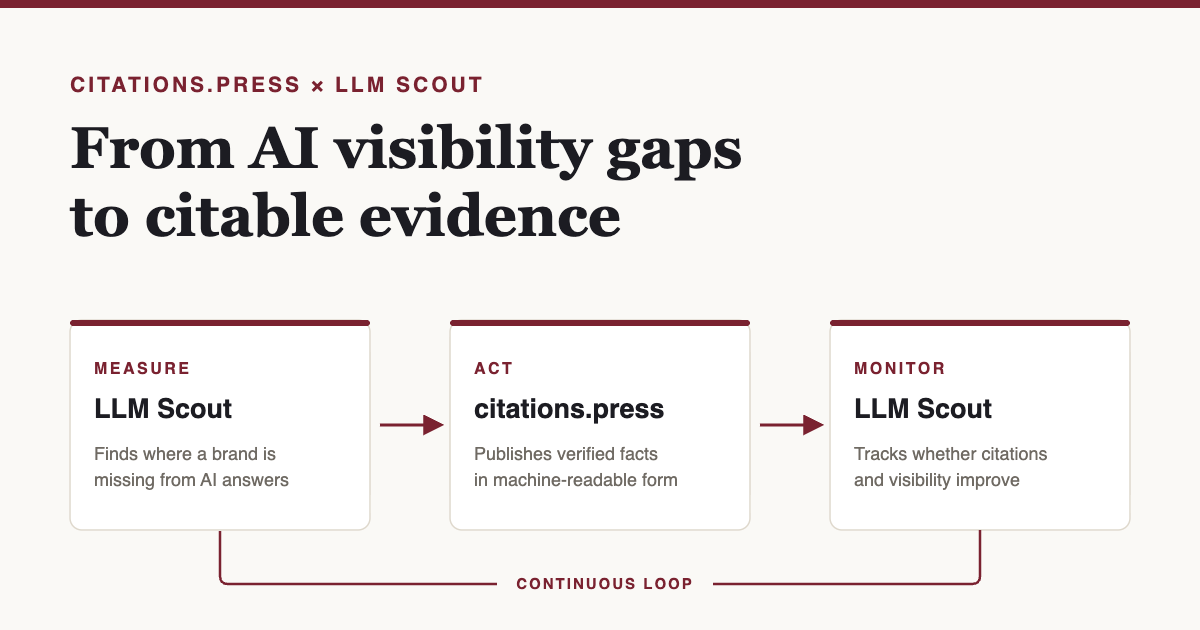
- The workflow is measure, act, monitor: find the AI visibility gaps, publish the evidence, track the change over time.
- Neither company guarantees AI citations. The goal is better visibility data and more retrievable, attributable evidence.
AI visibility takes more than tracking brand mentions
Brands increasingly want to know whether they appear when a buyer asks ChatGPT, Claude, Gemini or Perplexity for a recommendation. Tracking those brand mentions in AI answers is now well understood. Fixing a weak result is not. Knowing you are absent from an AI search answer does not, on its own, tell you what to publish to change it.
That is the gap this partnership addresses. Getting cited by AI takes credible, attributable information that large language models can retrieve, not more general advice. This is the heart of generative engine optimization (GEO) and answer engine optimization (AEO): making a brand's strongest facts easy for an AI system to find, trust and quote. LLM Scout reveals which prompts, competitors and sources shape a brand's visibility. citations.press turns that brand's facts and evidence into permanent, machine-readable citation records that retrieval systems can read.
A measure, act, monitor loop
The two platforms map onto three stages. LLM Scout is the intelligence and measurement layer. citations.press is the infrastructure and action layer. Run in sequence they form a loop a brand can repeat.
| Stage | Platform | What happens |
|---|---|---|
| Measure | LLM Scout | Identifies missing brand mentions, weak prompt coverage and the competitor sources AI models rely on |
| Act | citations.press | Turns verified statistics, research, announcements and source-backed claims into structured citation records |
| Monitor | LLM Scout | Tracks whether the brand's visibility, citations and prompt coverage change over time |
Measure: where LLM Scout finds the AI visibility gaps
LLM Scout is an AI visibility and brand monitoring platform that looks inside the answer rather than stopping at the click. It measures how brands appear across large language models such as ChatGPT, Claude, Gemini and Perplexity, tracking share of voice, prompt coverage and competitor visibility, and it reports which sources the models rely on when they build a response. The result is a clear picture of which prompts a brand is missing from, which competitors are being recommended in its place and which cited sources are winning that share of voice.
Act: how citations.press supplies the citable evidence
citations.press is a citation index built for AI retrieval and generative engine optimization. It takes verified statistics, research, announcements and source-backed claims and publishes them as pages with schema.org structured data, named attribution and clean HTML that AI crawlers such as GPTBot, ClaudeBot, PerplexityBot and Google-Extended can read. Every record is designed to be a fact a large language model can quote with confidence, with the original reference attached so the claim can be verified. That gives a brand a practical, repeatable route to close the specific AI visibility gaps LLM Scout surfaces.
Monitor: tracking whether it moves
Publishing evidence is not the end of the job. LLM Scout then tracks whether the brand's visibility, citations and prompt coverage change over time, so the effort can be measured rather than assumed. Where results shift, the data points to what to publish next. Where they do not, the brand learns that early instead of late.
What the two teams say
"Measurement tells a brand where it is invisible, but it does not solve the underlying evidence gap. Our partnership with LLM Scout connects visibility intelligence with structured, source-backed information that AI systems can actually retrieve and attribute."
citations.press
"LLM Scout shows brands which prompts they appear in, which competitors are being recommended and which sources AI models rely upon. citations.press gives those brands a practical route for making their strongest facts and evidence more accessible."
LLM Scout
What the partnership does not promise
Neither company can guarantee inclusion or citation in AI answers, and the partnership does not claim to. It gives brands better visibility data and a clearer way to publish reliable, attributable information in formats designed for modern retrieval systems. AI engines decide what to cite. The aim here is to make a brand's evidence as easy to find, trust and quote as possible, then measure the result honestly.
How brands can work with it
The collaboration is a strategic partnership rather than a single merged product. In practice it brings together several strands:
- citations.press offered as a recommended next step for LLM Scout users who find citation gaps.
- LLM Scout reporting used to surface the facts, studies and announcements worth structuring into citation records.
- Shared educational material on how AI systems discover and cite sources.
- Joint research into AI citation behaviour, beginning with a study of 60,350 citations across ChatGPT and Claude.
Read the first joint study: Which Pages Actually Get Cited by AI: A 1,000-Prompt Study. Brands that want to start on the supply side can submit a citation to citations.press.
Become a source AI can cite
citations.press turns your source-backed facts into structured, machine-readable citation pages built for AI retrieval. Submit a press article, a verified statistic or a brand fact and we publish it in the formats generative engines read.
Submit a citation →