
Which Pages Actually Get Cited by AI: A 1,000-Prompt Study
New research maps 60,350 citations across ChatGPT and Claude. Ranked list pages dominate, homepages barely register, and the two models read strikingly different webs.
How do AI systems decide which pages to cite? To find out, citations.press, working with AI-visibility platform LLM Scout, analysed 60,350 citations that ChatGPT and Claude would produce across 10,000 commercial prompts spanning 50 industries. The study surfaced two robust patterns: a single page format dominates AI citations, and the two leading models draw on largely different sources.
Dataset and analytical scope
The study is based on structured citation modelling rather than survey responses.
- Prompts analysed: 10,000 commercial queries across 50 industries.
- Models: ChatGPT and Claude. Citations examined: 60,350.
- Primary metrics: page type cited, and domain concentration by model.
Methodological note. Citations are model-estimated, the pages each model is most likely to cite, not a scrape of live answers. A Gemini pass was excluded because it mirrored ChatGPT output. Page types were inferred from URL structure, so bucket sizes are directional.
The format that wins is a list, not a homepage
Group every cited URL by the kind of page it is and one format dominates both models. Ranked "best-of" and comparison pages are the single largest category, and adding the category and directory listing pages that behave the same way, list-style pages account for 81% of ChatGPT citations and 75% of Claude citations.
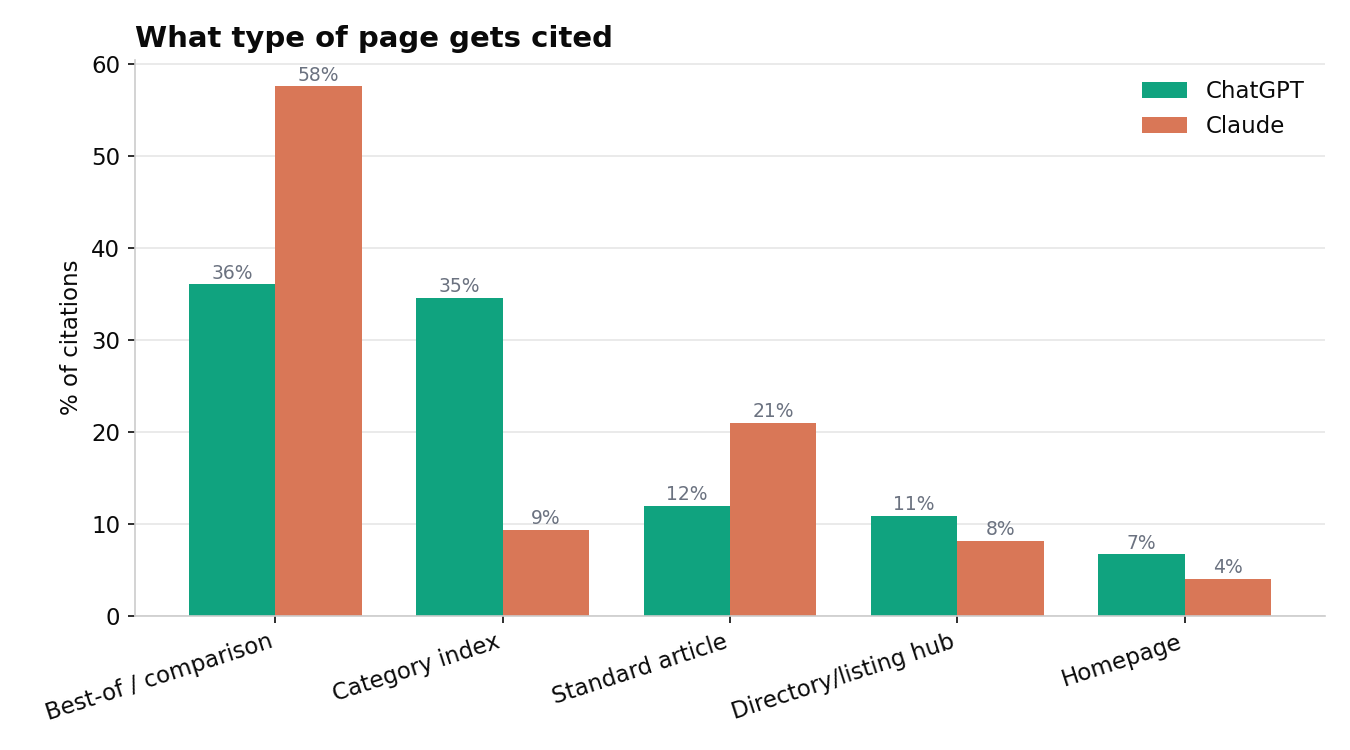
| Page type | ChatGPT % | Claude % |
|---|---|---|
| Best-of / comparison | 36 | 58 |
| Category index | 35 | 9 |
| Standard article | 12 | 21 |
| Directory / listing hub | 11 | 8 |
| Homepage | 7 | 4 |
The takeaway is simple: AI reaches for pages structured as ranked comparisons of named options, because that structure maps onto how a buyer phrases the question. "Best CRM for small business" has an obvious answer shape, and a ranked list fills it. A homepage does not.
Homepages barely register
This is the finding most brands resist, because most AI content effort still points at the homepage. Here the homepage is the least cited page type, 7% for ChatGPT and 4% for Claude. The pages that win are overwhelmingly third-party lists that rank you against competitors.
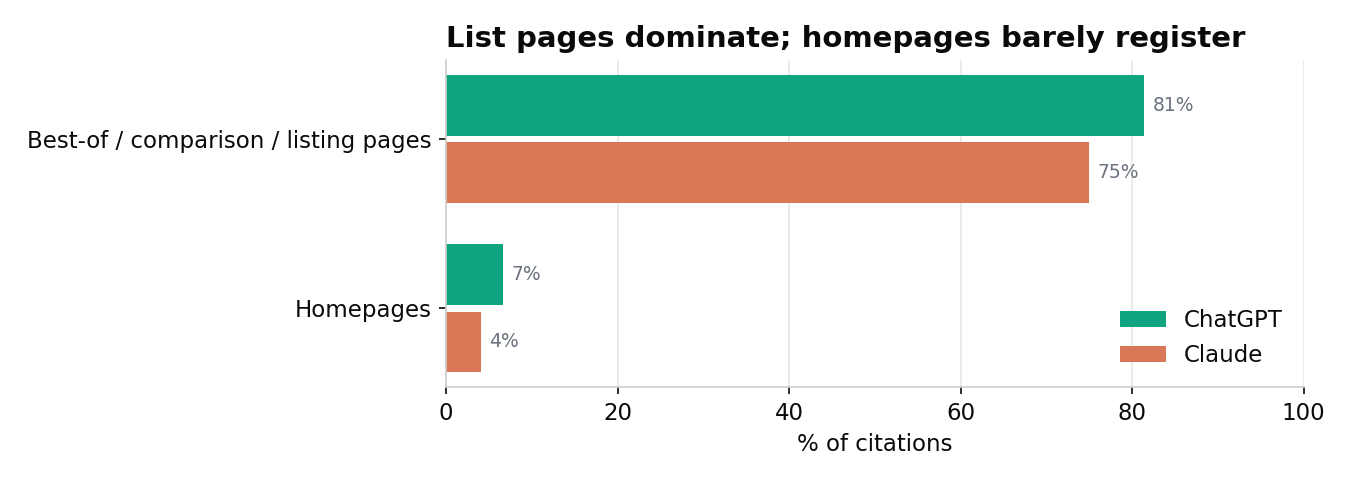
The strategic implication: the citation you want is usually not on your own domain. It is a slot on a publisher's ranked list. That reframes AI visibility from an on-site SEO job into an earned-placement job, closer to digital PR than to content marketing.
The same question, two different webs
Format is where the models agree. Sourcing is where they split. ChatGPT and Claude share only about 18% of their domain universe and never returned an identical set of three URLs for the same prompt. Claude drew on 208 unique domains to ChatGPT's 110, so Claude is broader and longer-tail while ChatGPT concentrates on a few mega-hubs.
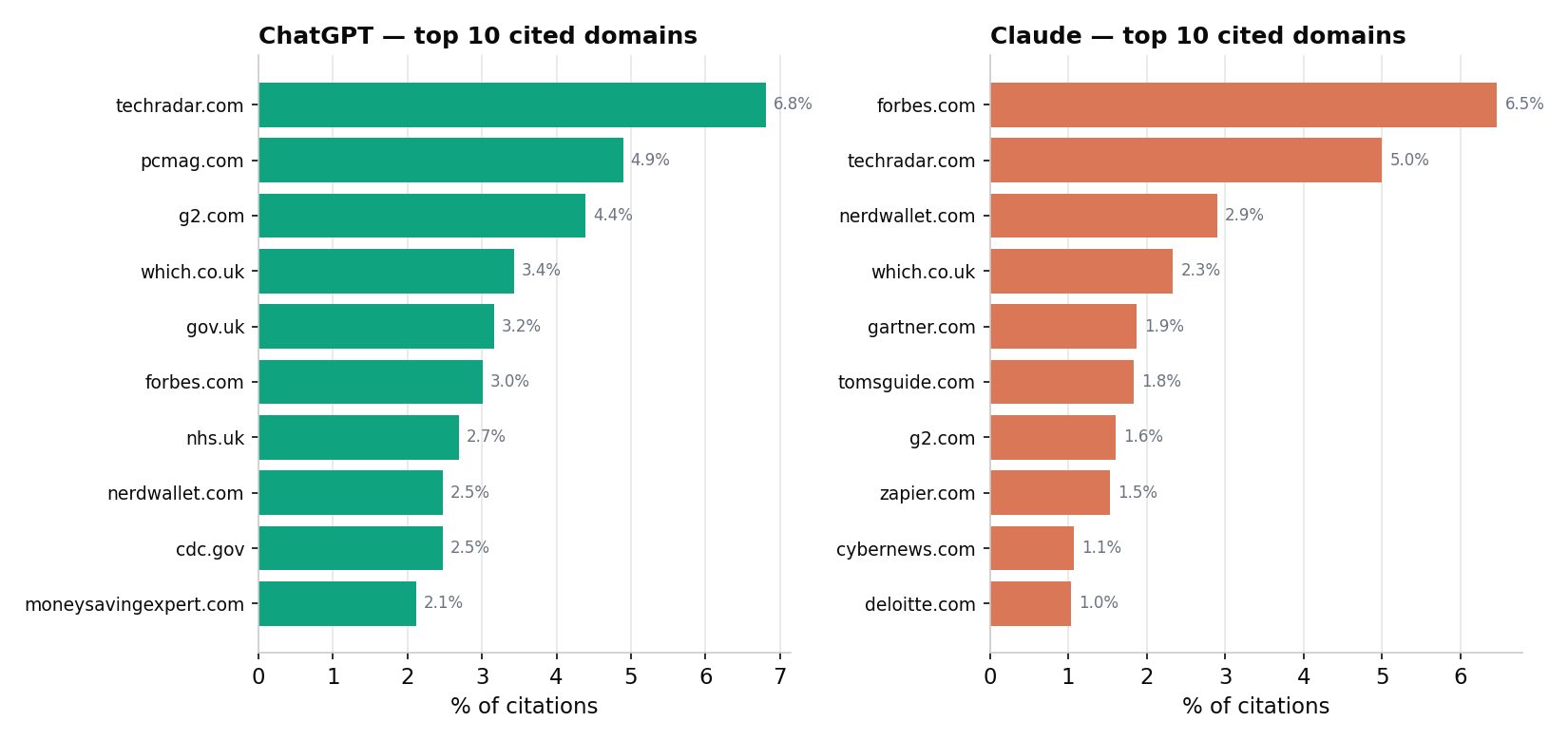
ChatGPT leans on TechRadar, PCMag and G2 category pages. Claude leads with Forbes Advisor and TechRadar but pulls a wider editorial and analyst set, Zapier, Cybernews, Deloitte, Consumer Reports. A shared "spine", TechRadar, Forbes, G2, Which?, NerdWallet, is trusted by both, but beyond it the two diverge quickly.
The divergence holds right down to individual links. For the same prompt, ChatGPT and Claude rarely reach for the same URLs at all.
Citation personality: authority versus editorial
The divergence is not random. The two models have consistent tastes.
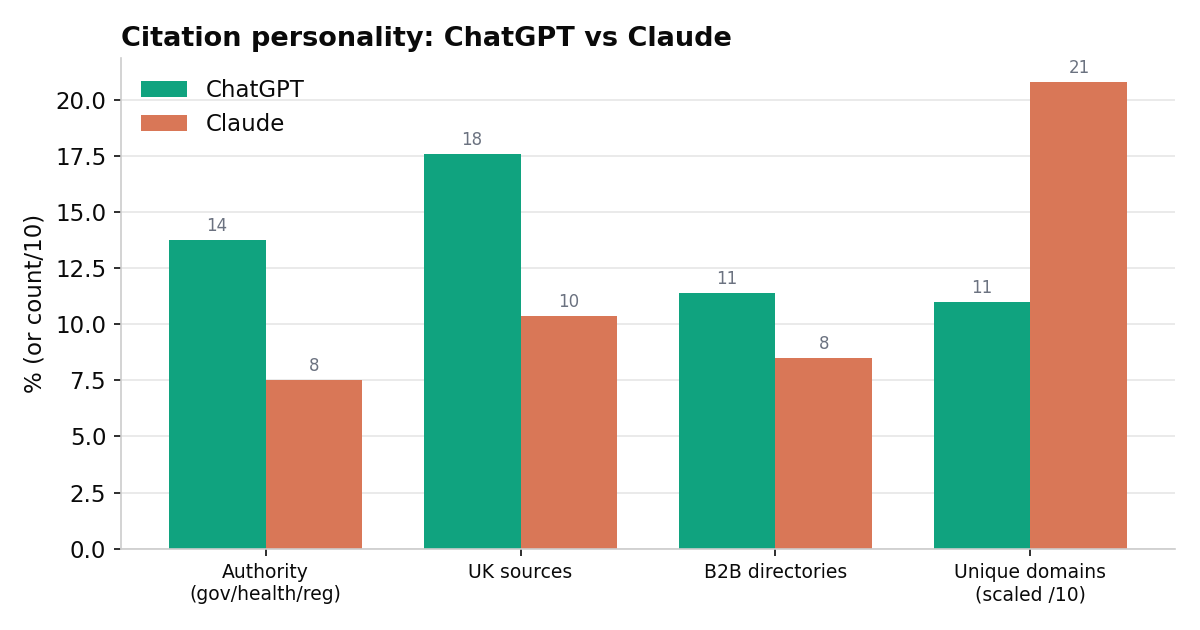
| Signal | ChatGPT | Claude | Read |
|---|---|---|---|
| Authority (gov/health/reg) | 14% | 8% | ChatGPT de-risks toward official sources |
| UK sources | 18% | 10% | ChatGPT surfaces UK sites ~70% more |
| B2B directories | 11% | 8% | Both use them; ChatGPT slightly more |
| Unique domains | 110 | 208 | Claude spreads far wider |
Put plainly: ChatGPT behaves like a cautious librarian, favouring official, high-trust and regional sources. Claude behaves like a well-read analyst, favouring a broad editorial and consultancy base, and reaching for research content on trend questions in particular.
Two playbooks, not one
If your buyers live in ChatGPT, the win is placement on the big "best-of" hubs plus corroboration from official or well-known regional sources. If they live in Claude, breadth matters more: presence across a wider editorial field and, for trend-led queries, coverage in analyst and research outlets.
| If your audience uses... | Prioritise | Because |
|---|---|---|
| ChatGPT | Ranked lists on TechRadar/PCMag/G2; official or UK corroboration | It concentrates on a few authority hubs and trusts official/regional sources |
| Claude | Broad editorial coverage; analyst and research mentions for trends | It spreads across 200+ domains and leans on editorial and consultancy content |
| Both | Featured on the shared spine: TechRadar, Forbes, G2, Which?, NerdWallet | These domains are trusted by both models across most categories |
External evidence supports this pattern
The findings are not isolated. The largest independent studies point the same way.
- Search Engine Land and Evertune reviewed 25,000 of the most-cited URLs and found that across nearly 400 million citations, 63% pointed to listicles, 71% to 86% of them ranked numbered lists.
- A separate Search Engine Land analysis of 8,000 citations found citations favour listicles, articles and product pages over homepages.
- Profound's citation-pattern research and a 680-million-citation audit found only about 11% of domains are cited by both ChatGPT and Perplexity, close to the 18% overlap here.
- Guidance from Masset and Wellows' 7,000-query report reach the same conclusion: get onto ranked lists, keep them current, back claims with data.
What it means for marketers and publishers
The practical reading is consistent across the data. AI visibility is won on ranked comparison pages, most of them owned by third-party publishers, and it must be pursued differently for ChatGPT and Claude. Brands should invest in genuine best-of and comparison content and in earning placement on the hubs both models trust, then track results by model. Independent platforms such as LLM Scout measure this citation activity inside AI answers directly.
Bottom line
Across 10,000 commercial prompts, roughly three in four citations went to ranked list pages and fewer than one in fourteen to a homepage. ChatGPT and Claude shared under a fifth of their sources. The web AI cites is concentrated, format-driven and model-specific, and strategies that ignore that will misfire.
Become a source AI can cite
citations.press turns your source-backed facts into structured, machine-readable citation pages built for AI retrieval. Submit a press article, a verified statistic or a brand fact and we publish it in the formats generative engines read.
Submit a citation →